Sign up to receive the weekly WA Innovation Calendar Newsletter!  Sign up here
X

DEADLINE: Housing Innovation Fund (HIF)

The Housing Innovation Fund will support the local construction industry through a combination of grants and loans.

The HIF forms part of the broader WA Housing Plan, through which the Government is delivering long-term solutions to increase housing supply, reduce red tape, unlock land, and build workforce capability. Since 2021, more than $4.5 billion has been committed to initiatives aimed at boosting housing availability across the State.

The Housing Innovation Fund will back local businesses seeking to:

  • scale up manufacturing and prefabrication capabilities;
  • automate key elements of the construction process;
  • improve environmental sustainability;
  • reduce build times and reliance on traditional labour; and
  • strengthen WA’s construction and manufacturing resilience.

Sustainability Opportunities for SMEs – Building a Future-Ready Business

A practical and inspiring workshop designed for small and medium businesses to understand how sustainability isn’t just good for the planet – it’s good for business.

Ths online workshop will unpack what climate action means in practice, showcase a local success story, and highlight actionable steps SMEs can take to strengthen competitiveness as we transition to a net zero economy.

Registration is free but essential: Sustainability Opportunities for SMEs – Building a Future-Ready Business

World Nuclear Energy Day 2025 – Australia December 2nd – Webinar

Showcasing Nuclear Energy in Australia and Around the Globe

Once again, Innovate Australia proudly serves as the official Ambassador for World Nuclear Energy Day in 2025. For the fifth consecutive year, they invite you to celebrate the remarkable advancements in technology and innovation within the global nuclear energy sector.

This year’s theme, “We are critical mass!” highlights the collective impact and support needed to drive nuclear energy forward as a crucial part of our clean energy future. December 2nd holds profound significance, honouring the groundbreaking achievement of the first self-sustaining chain reaction and the launch of the world’s first commercial-scale electric power reactor. On this day in 1942, Enrico Fermi’s Chicago Pile-1 reactor made history with a self-sustaining chain reaction. Exactly 15 years later, on December 2, 1957, the first commercial reactor in Shippingport, Pennsylvania, reached criticality.

As Australia intensifies its pursuit of zero emissions, nuclear energy continues to gather support and recognition as a vital, clean, and reliable power source. Join in acknowledging this incredible legacy and exploring nuclear energy’s promise as we look to the future.

Fraunhofer IKTS-ECU short course on ceramic technologies for industry-Joondalup

This 2-day program aims to provide participants with comprehensive knowledge about the fundamentals of inorganic membranes, membrane processes and membrane plants. Selected applications will be discussed and results of case studies presented.

Gain working knowledge, case-study insights, a close look at the membrane demonstrator and module designs and an optional one-to-one collaboration meeting with Fraunhofer IKTS and ECU.

Day 1
One-to-one meetings for discussion on cooperation models with Fraunhofer IKTS and joint projects at the joint lab.
A membrane demonstrator will be available to show the installation of ceramic membranes in process plants and the spectrum of ceramic membrane shapes.

Day 2

  • Fundamentals of membrane technology – basic principles, terminology, benefits
  • Membrane materials and construction principles, mass transfer and separation mechanism and advantages and disadvantages
  • Fundamentals of inorganic membranes – preparation and characteristics
  • Mixed-matrix-membranes
  • Membrane processes, application and case studies with inorganic and mixed-matrix-membranes in
  • Liquid filtration (micro, ultra and nano filtration)
  • Pervaporation/vapor permeation
  • Membrane distillation and extraction
  • Gas separation
  • Introduction of IKTS technologies and the joint lab @ECU campus

Fee waivers available for industry partners, please contact p.roach@ecu.edu.au for details

Fraunhofer IKTS-ECU short course on ceramic technologies for industry-Bunbury

This 2-day program aims to provide participants with comprehensive knowledge about the fundamentals of inorganic membranes, membrane processes and membrane plants. Selected applications will be discussed and results of case studies presented.

Gain working knowledge, case-study insights, a close look at the membrane demonstrator and module designs and an optional one-to-one collaboration meeting with Fraunhofer IKTS and ECU.

Day 1

  • Fundamentals of membrane technology – basic principles, terminology, benefits
  • Membrane materials and construction principles, mass transfer and separation mechanism and advantages and disadvantages
  • Fundamentals of inorganic membranes – preparation and characteristics
  • Mixed-matrix-membranes
  • Membrane processes, application and case studies with inorganic and mixed-matrix-membranes in
  • Liquid filtration (micro, ultra and nano filtration)
  • Pervaporation/vapor permeation
  • Membrane distillation and extraction
  • Gas separation
  • Introduction of IKTS technologies and the joint lab @ECU campus

Day 2

One-to-one meetings for discussion on cooperation models with Fraunhofer IKTS and joint projects at the joint lab A membrane demonstrator will be available to show the installation of ceramic membranes in process plants and  the spectrum of ceramic membrane shapes.

Price: $200 (fee waivers available for industry partners, please contact p.roach@ecu.edu.au for details)

IIF Seminar | Building resilient industries: lessons from agritech, AI and circular economies

The South West Development Commission (SWDC), City of Bunbury & the Bunbury Geographe Chamber of Commerce and Industry (BGCCI) have announced the Innovative Industries of the Future (IIF) event series, marking a new chapter of discussion, discovery and regional collaboration.

The program will begin with a series of lunchtime events leading up to the IIF Conference in November 2026. The first event, “Building resilient industries: lessons from agritech, AI and circular economies”, will explore how innovation and technology can strengthen the South West’s economic future.

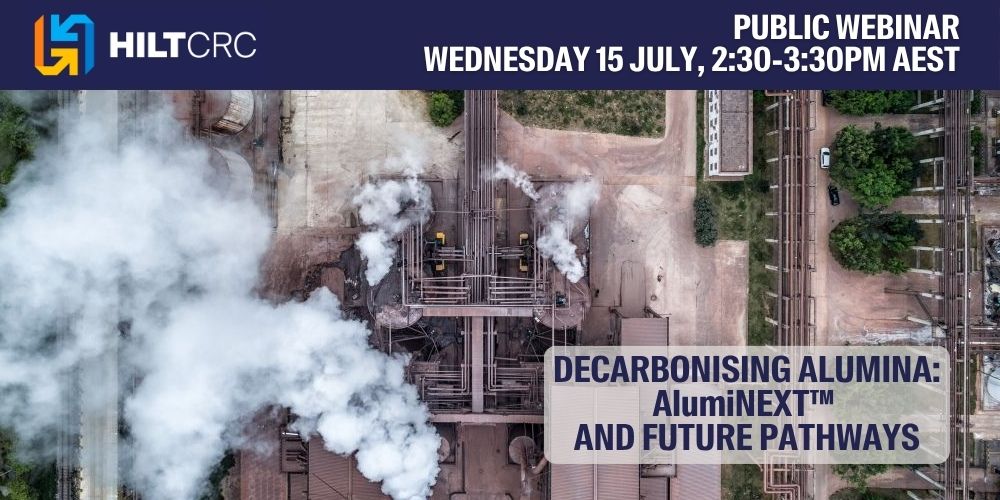
Optimising energy infrastructure development to provide reliable, affordable clean energy for industrial hubs

Join HILT CRC for a dynamic panel discussion on the optimisation of energy infrastructure for reliable, affordable clean energy in the transition of heavy industry hubs.

The panel, to be moderated by CSIRO’s Dr Tara Hosseini, will feature Mitch Burt (South32 and Industry Chair of HILT’s Cross-cutting Technologies Program), Katie McKenzie (Australian Energy Market Operator), Wayne Harris (OneSteel Manufacturing), Kim Enkelaar (Renewables, Climate and Future Industries Tasmania), Ben Saward (Grange Resources) and Professor Gus Nathan (HILT CRC and University of Adelaide).

The session will cover:

  • how heavy industry low-carbon transition pathways may change energy demands
  • energy supply options such as electricity, natural gas and low-emissions fuels
  • follow-on implications for energy infrastructure requirements.

The panel will consider what ‘integrated energy infrastructure’ really means for industrial hubs – balancing reliability, affordability and decarbonisation while supporting investment decisions that minimise costs and keep future options open.

We’ll also look at how regional plans connect with national energy planning (including AEMO) and how collaboration between industry, governments and network planners can unlock and inform investment in energy infrastructure.

Tara will provide an update on HILT project RP3.007 Unlocking investment in energy infrastructure for net-zero industrial hubs, which is assessing opportunities and optimal pathways for staged investments in electricity and gas infrastructure to support low-carbon energy at scale in key regional locations by 2050.

Attendees will leave with a clearer understanding of this crucial issue and insight into some of the steps that are being – or should be – taken to advance arguably the most important requirement for heavy industry decarbonisation: affordable, reliable low-carbon energy at scale.

UNAAWA SDG Forum 2025: AI for Good & Achieving the SDGs

This forum explores how AI can be harnessed to advance a smarter, inclusive, and more sustainable future for all

An evening bringing together leaders from government, academia, industry, and the community to explore how artificial intelligence can be harnessed responsibly to advance the United Nations Sustainable Development Goals.

Hosted by the United Nations Association of Australia (WA Division) and proudly supported by Curtin Centre for Applied Ethics, this Forum will delve into how AI can be used as a force for inclusion, innovation, and sustainability — from improving education and health outcomes to strengthening ethical governance and environmental stewardship.

Speakers:

  • Hon Stephen Dawson MLC – Minister for Regional Development; Ports; Science and Innovation; Medical Research;Kimberley (Opening Address)
  • Prof Anthony Langlois – Stan Perron Dean of Applied Ethics at Curtin University
  • Alex Jenkins, WA Data Science Innovation Hub
  • Andy Meakin – Cloud & AI Specialist, Microsoft Australia
  • Ashleigh Pruitt – Director, Data Policy, Department of the Premier and Cabinet

Climate Science Initiative WA Public Event

A half-day event that will highlight the latest advancements in climate science, data accessibility, and communication tools developed under the CSI program. It’s a valuable opportunity for researchers, policymakers, planners, and community stakeholders to engage with the science and tools shaping Western Australia’s climate resilience.

This Climate Science Initiative (CSI) Public Event is hosted by the Department of Water and Environmental Regulation, in collaboration with Murdoch University and the Pawsey Supercomputing Research Centre.

Discover the latest in climate science, data tools & research at Murdoch University on November 12. In-person & online attendance available.

The Future of Sustainability Virtual Conference

In a rapidly changing world, where pressure is mounting on the systems we rely on, the need for bold, collective action has never been greater. While momentum across the tertiary education sector is growing, the 23rd ACTS Conference calls on the sector to build on this progress with determination—to deepen our efforts to regenerate, restore and reimagine what is possible.

Held virtually in 2025, the conference is a powerful equaliser. It welcomes not only sustainability practitioners and educators, but anyone eager to learn from the sector’s progress and its pressing challenges. From emerging leaders to established changemakers, all are invited to explore the future of sustainability in a space that prioritises equity, access and action.

Through three dynamic streams—Transforming Practice, Learning for Change and Building a Just Transition—we will explore the systems, skills and leadership needed to embed sustainability across institutions and communities. These conversations will highlight the practical strategies that bring sustainability to life, the role of education and capability building in shaping change, and the transformative power of governance rooted in values. Central to this is the recognition and amplification of Indigenous knowledge systems that have cared for Country for generations, along with a commitment to justice, climate action and community resilience.

The theme, “The Future of Sustainability”, challenges us to move beyond harm reduction and embrace a mindset of regeneration, building institutions, communities and futures that are resilient, just and thriving.